Redfish

UniStream Built-in PLCs support Redfish, a highly scalable RESTful API protocol, as a server.

The Redfish Scalable Platforms Management API, developed by the Distributed Management Task Force (DMTF), is a modern standard for systems management interfaces. It offers a scalable, secure, and open method for managing servers, utilizing RESTful interface semantics to access model-based data for out-of-band management.

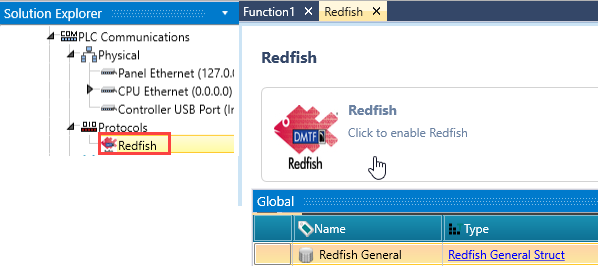
Enabling Redfish

Redfish General Struct

Parameter Name

Type

Purpose

Process Status

UINT8

These indicate the status of the process

0 - Redfish Initialization in Progress

1- Redfish is running

2 - Certificate expired

3 - Bad Configuration

4 - Internal error

5 - Restart server after creating new certificate

User Name

String ASCII

This shows the last username accessed 

Num of Access

UINT32

This shows the number of times the object or resource has been accessed

Event UTC Time

UINT32

This shows the timestamp of the event in Coordinated Universal Time (UTC)

Event Type

UINT8

These indicate the event type codes

0 - Invalid user request

1- User GET request

2 - User PATCH request

3 - User unauthorized request

4 - Internal error

5 - User POST request


Server Configuration

Settings

The setting shown below are the default settings.

You may edit these except for End Point; this is automatically generated by UniLogic.

The End Point is the identifier the client will use to identify the server; you can copy and paste the identifier into your client.

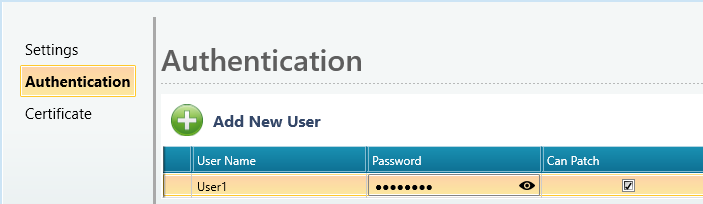
Authentication

Click Add New User.

Click the fields and enter the User Name and Password 

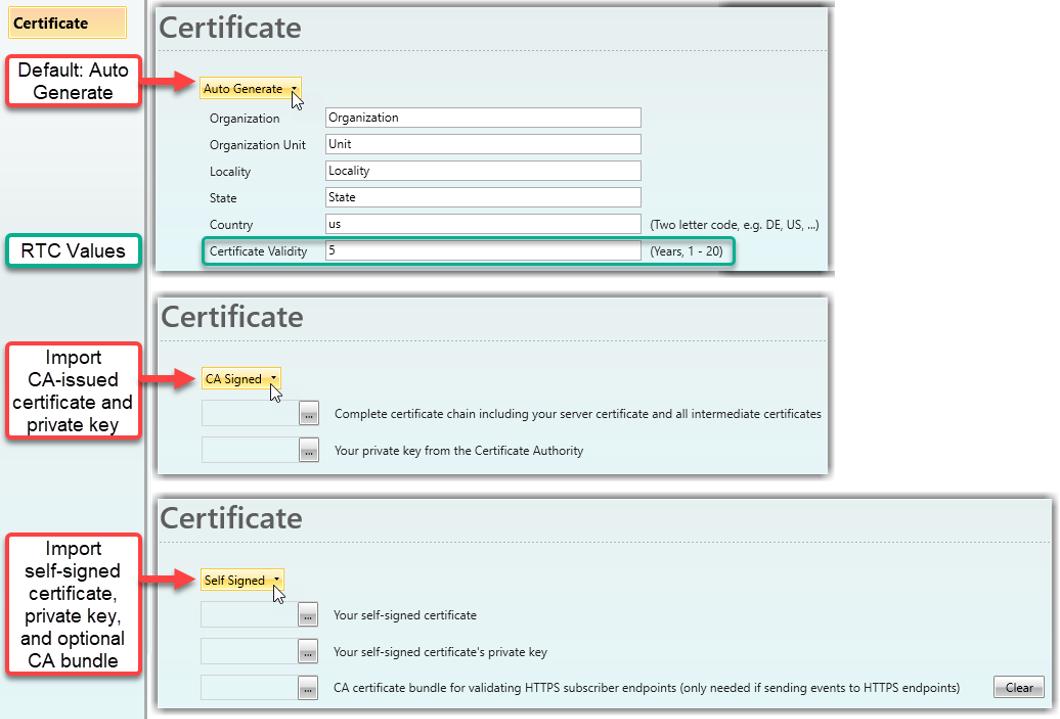
Certificate

By default, the Certificate is auto-generated for users with an SD card and saved in "/ExternalSD/Redfish/RedfishUniStreamCert.crt"; uncheck the option if you wish to import the certificates manually.

Note that a new Certificate is generated whenever an IP address changes, therefore, upon changing the PLC Panel IP, download the Certificate again from the SD card.

Note that the RTC in the PLC must be set correctly in order to correctly implement the Certificate Validity.


Redfish Data Modeling 

Responses to Redfish requests consist of JSON packets containing key/value properties defined by the DMTF in a schema file.

The schema defining the root of the Redfish tree is the #ServiceRoot. 

Links contained in the Redfish root tree, do not provide direct access to the properties of the server subsystems. Instead, they point to resource collections.

A resource collection is a core concept in Redfish. A resource collection is a group of like resources where the number of instances in the group can shrink or grow depending on the scope of the Redfish service or the configuration of the devices being managed. Every resource collection contains the same set of supported properties, and all contain Collections in the name of their schema. Every resource linked in the Members array within a resource collection will have the same resource type with the same major version, but can vary in minor schema versions.

 Below is an example diagram of the resource tree, starting at the Redfish Service Root, containing all resources used to model a rack-based Cooling Distribution Unit (CDU). Other types of cooling systems, such as immersion cooling units, follow the same model.

Creating a Rack-Based CDU (Cooling Distribution Unit)

The Redfish CoolingUnit schema supports different types of gear, such as Cooling Distribution Units (CDUs), connected through Cooling Loops that service the equipment in a single rack. Cooling Loop definitions contain product information and show the connections  to and from the loop. This  enables software to follow the flow of coolant through its entire cycle in a facility-level cooling system as well as providing basic inventory functions.

The example below shows how UniLogic can both control coolant flow and regulate temperature. To interface with Redfish, a communication bridge or gateway is used to translate industrial protocols into Redfish-compliant RESTful commands.

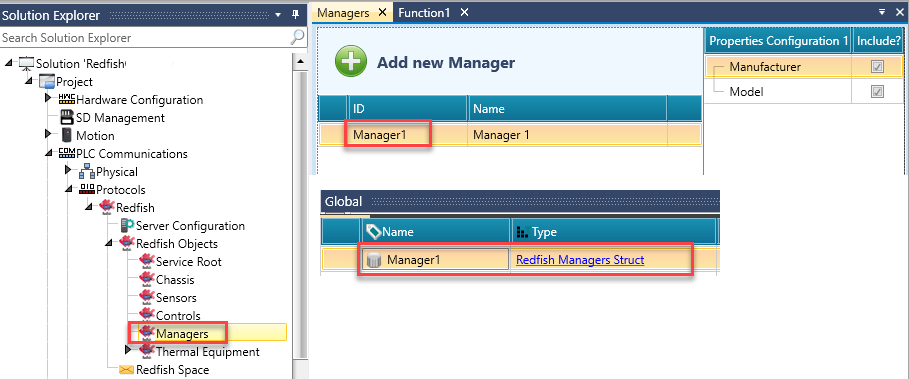
Redfish Objects - where you configure all resources, for example, all resources used to model a rack-based Cooling Distribution Unit (CDU).

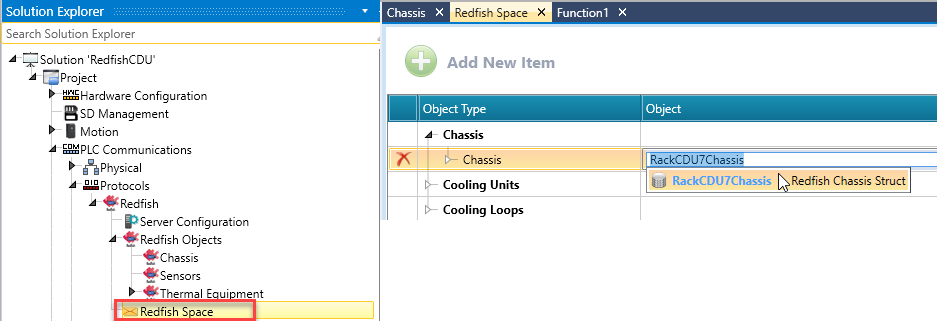
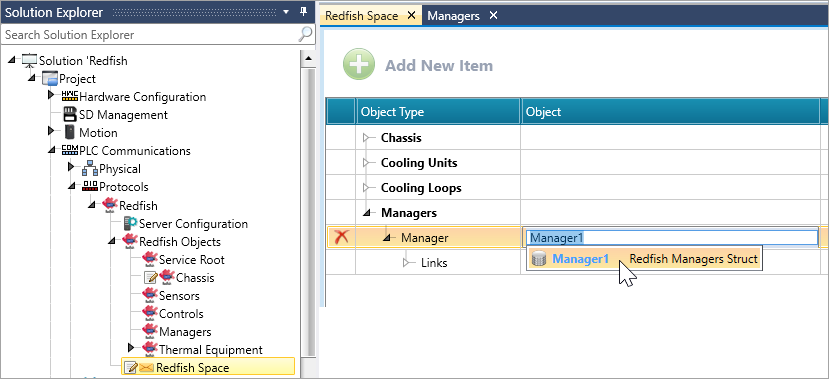
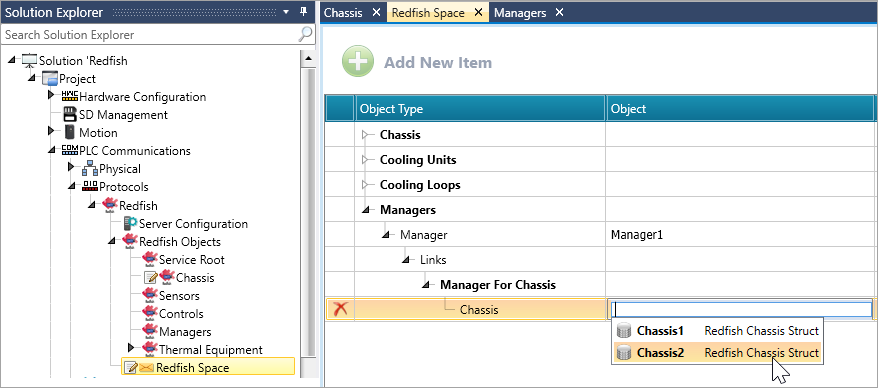
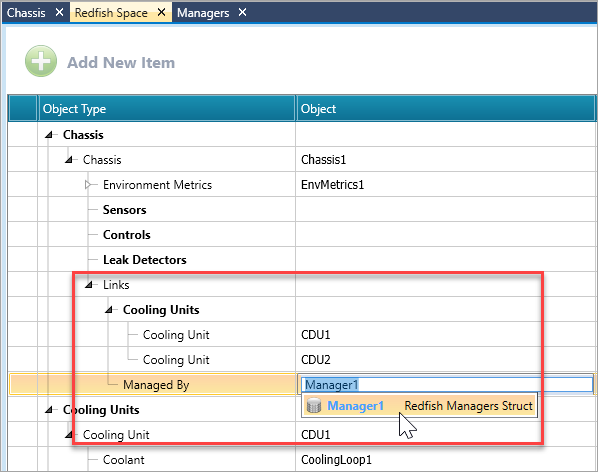
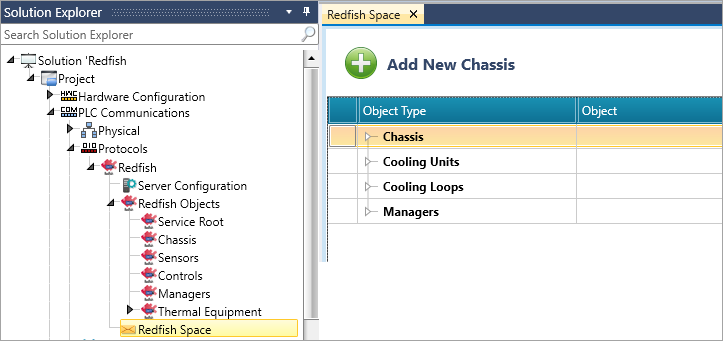
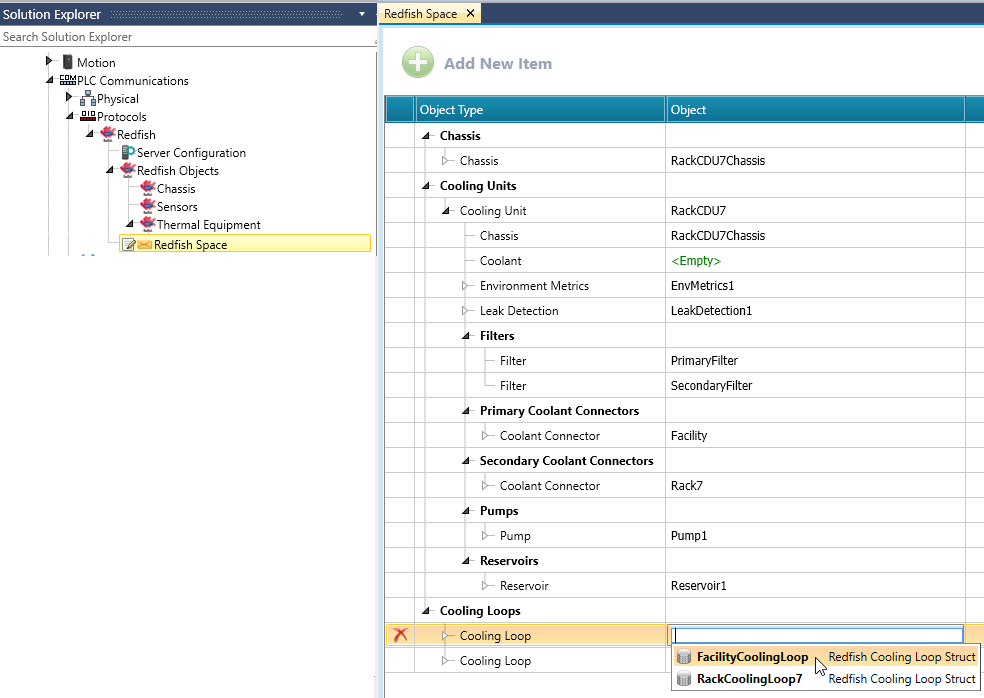
Redfish Space - where you link your resources accordingly.


Redfish Objects


Notes

  • An ID is a unique identifier throughout the entire project and can be used on only one resource.

  • Once an Object is defined, each additional object will contain the same set of supported Global Properties.

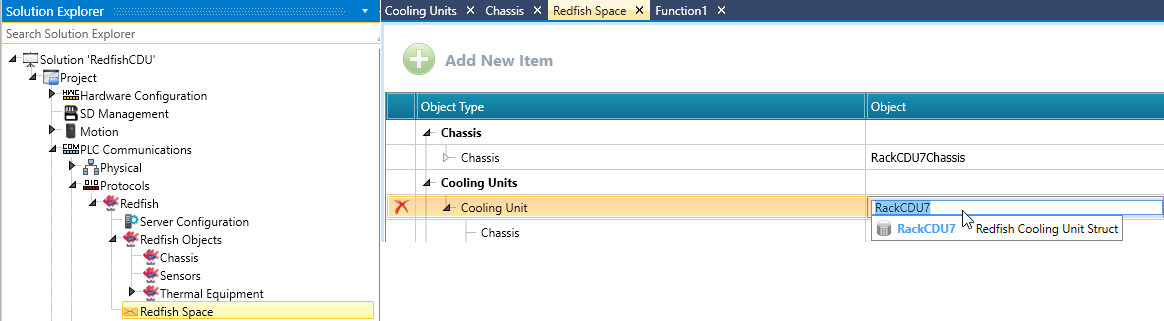
  • After defining Redfish Objects, make sure to assign the object within the Redfish Space.

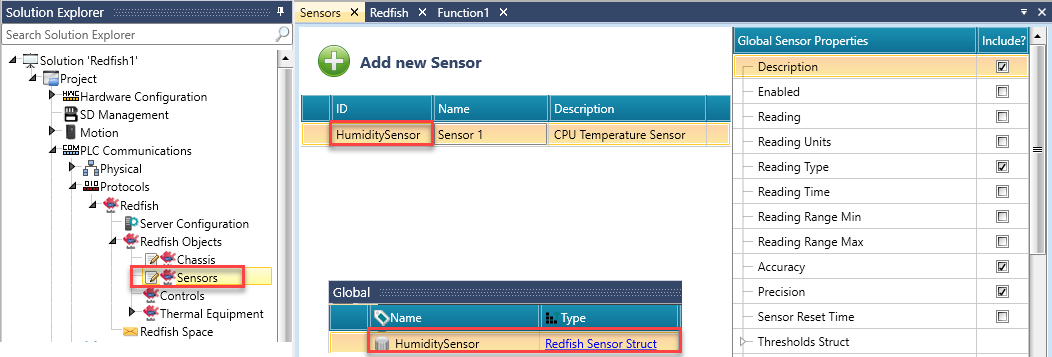
Chassis

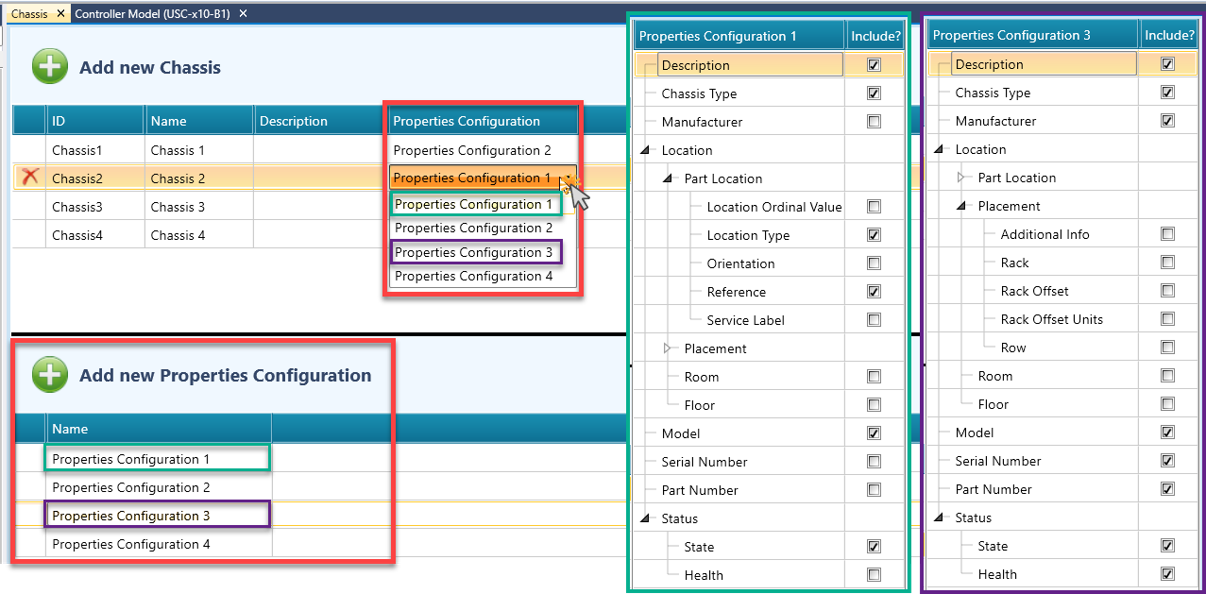
  1. Select Chassis on the Solution Explorer and click Add new Chassis.

  2. UniLogic automatically assigns editable ID, Name and Description fields. 

  3. Select to include or exclude the required Properties by checking/unchecking the Properties check-boxes.

  4. UniLogic creates the Chassis along with a supporting Chassis Struct.

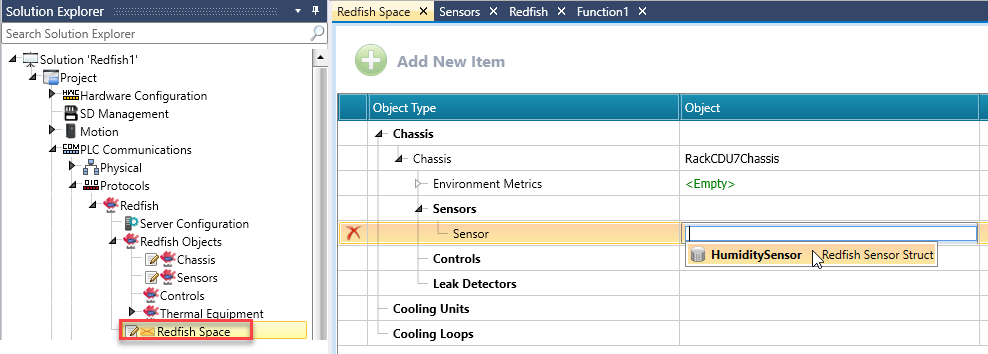
  5. Select Redfish Space on the Solution Explorer, click Chassis > Add New Chassis and link your Chassis struct.


Controls

The Control Object includes the following capabilities:

Notes

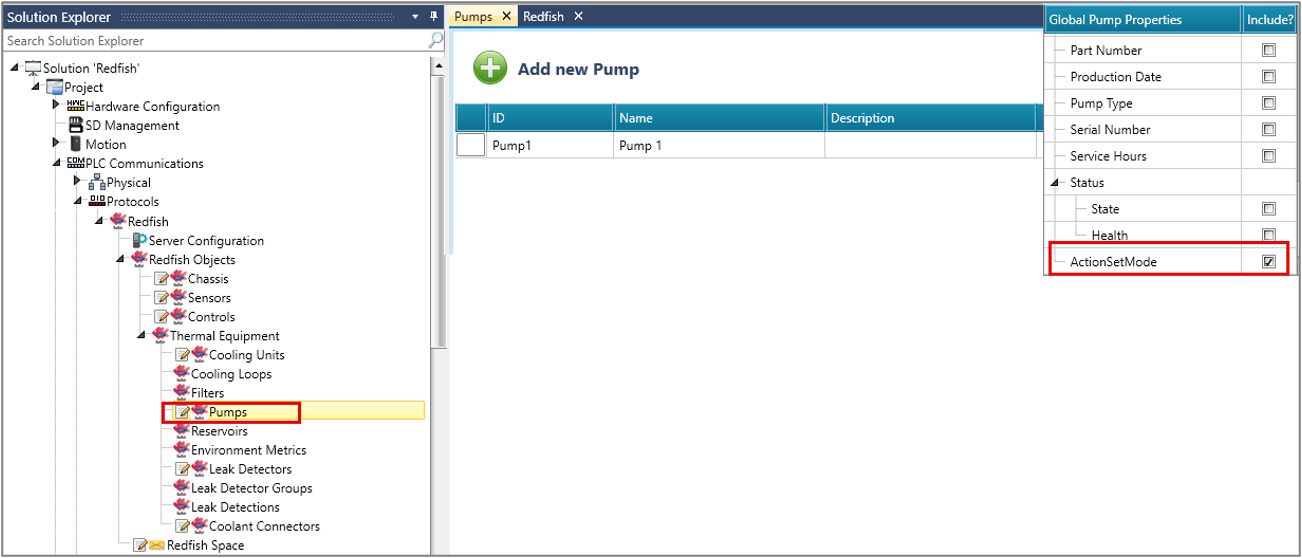
  • Set Mode Action functionality is only available for Pumps and Cooling Units.

  • To enable this feature, check the "ActionSetMode" field in the Properties window

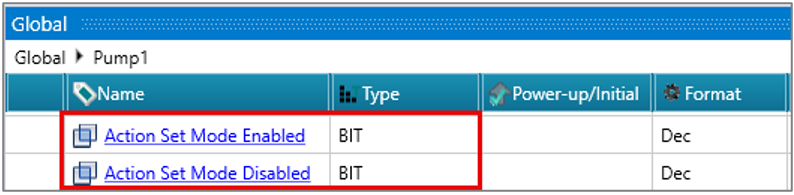
  • Action Set Mode Enabled and Action Set Mode Disabled states are now included as members of the CoolingUnit and Pump structs.

  • Users are responsible for tracking these enabled/disabled states.

  • To enable/disable, set the BIT to 0 in the Status State.


To configure Controls:

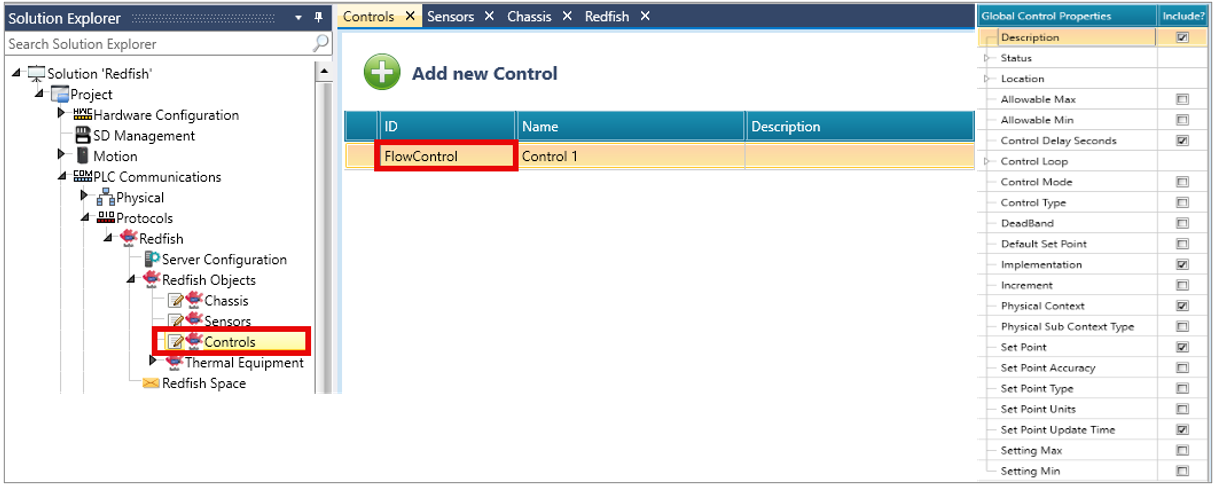
  1. Select Controls on the Solution Explorer and click Add new Control.

  2. UniLogic automatically assigns editable ID, Name and Description fields. 

  3. Select to include or exclude the required Properties by checking/unchecking the Properties check-boxes.

  1. UniLogic Creates the Control along with a supporting Control Struct.

  2. Select Redfish Space on the Solution Explorer, click Control > Add New Control and link your Control struct.


Thermal Equipment - Cooling Units

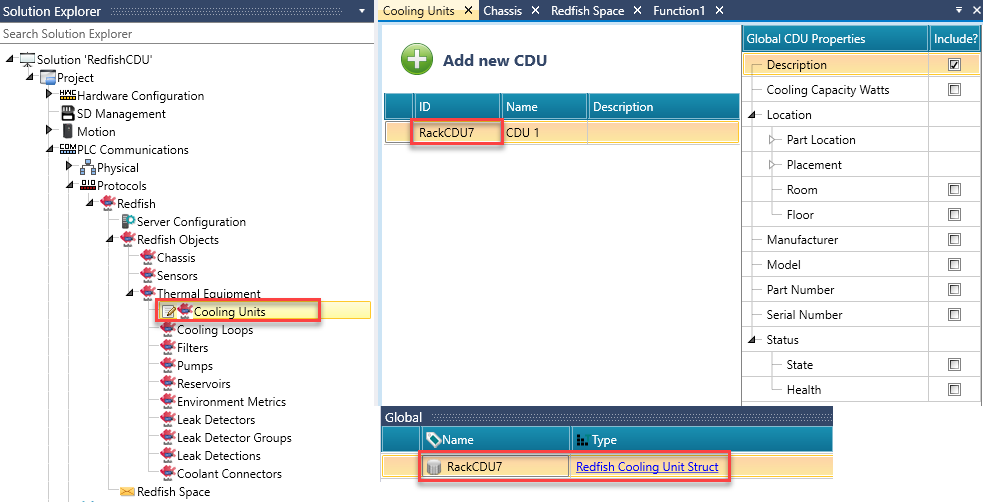
  1. Select Thermal Equipment on the Solution Explorer > Cooling Units > Add new CDU.

  2. UniLogic automatically assigns editable ID, Name and Description fields. 

  3. Select to include or exclude the required Properties by checking/unchecking the Properties check-boxes.

  4. UniLogic Creates the Cooling Unit along with a supporting Cooling Unit Struct.

  5. Select Redfish Space on the Solution Explorer, click Cooling Units > Add New Cooling Unit and link your Cooling Unit struct.


Thermal Equipment - Cooling Loops

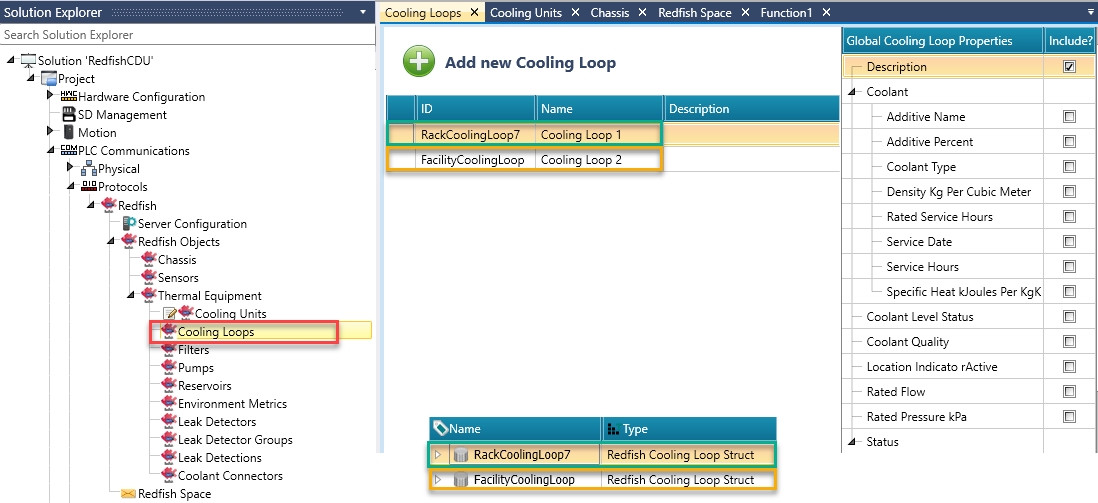
  1. Select Thermal Equipment on the Solution Explorer > Cooling Loops > Add new Cooling Loop.

  2. UniLogic automatically assigns editable ID, Name and Description fields. 

  3. Select to include or exclude the required Properties by checking/unchecking the Properties check-boxes.

  4. UniLogic creates two Cooling Loops with supporting Cooling Loop structs.  

  5. Select Redfish Space on the Solution Explorer, click Cooling Loops > Add New Cooling Loops and link your Cooling Loop structs.

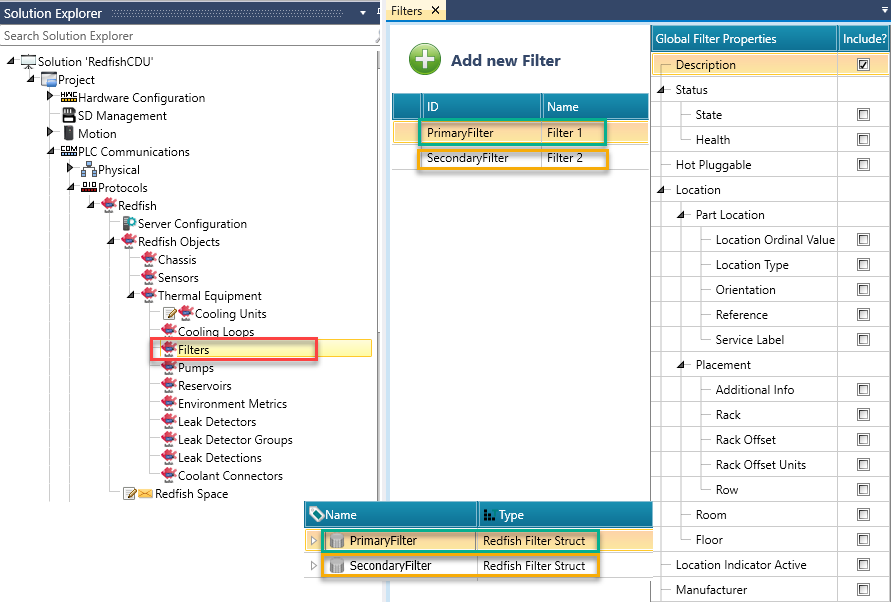
Thermal Equipment - Filters

  1. Select Thermal Equipment on the Solution Explorer > Filters > Add new Filter.

  2. UniLogic automatically assigns editable ID, Name and Description fields. 

  3. Select to include or exclude the required Properties by checking/unchecking the Properties check-boxes.

  4. UniLogic creates two Filters with supporting Filter structs.  

  5. Select Redfish Space on the Solution Explorer > Cooling Units > Cooling Unit > Filters > Add New Filter and link your Filter structs.

Thermal Equipment - Pumps

  1. Select Thermal Equipment on the Solution Explorer > Pumps > Add new Pump.

  2. UniLogic automatically assigns editable ID, Name and Description fields. 

  3. Select to include or exclude the required Properties by checking/unchecking the Properties check-boxes.

  4. UniLogic creates the Pump with supporting Pump struct.

  5. Select Redfish Space on the Solution Explorer > Cooling Units > Cooling Unit > Pumps > Add New Pump and link your Pump struct.

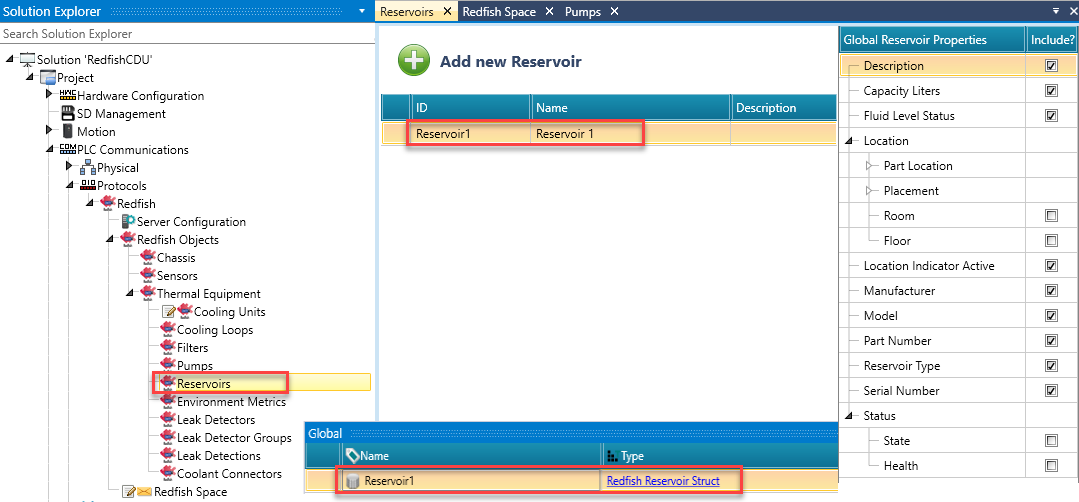
Thermal Equipment - Reservoirs

  1. Select Thermal Equipment on the Solution Explorer > Reservoirs > Add new Reservoir.

  2. UniLogic automatically assigns editable ID, Name and Description fields. 

  3. Select to include or exclude the required Properties by checking/unchecking the Properties check-boxes.

  4. UniLogic creates the Reservoir with the supporting Reservoir struct.

  5. Select Redfish Space on the Solution Explorer > Cooling Units > Cooling Unit > Reservoirs > Add New Reservoir and link your Reservoir struct.

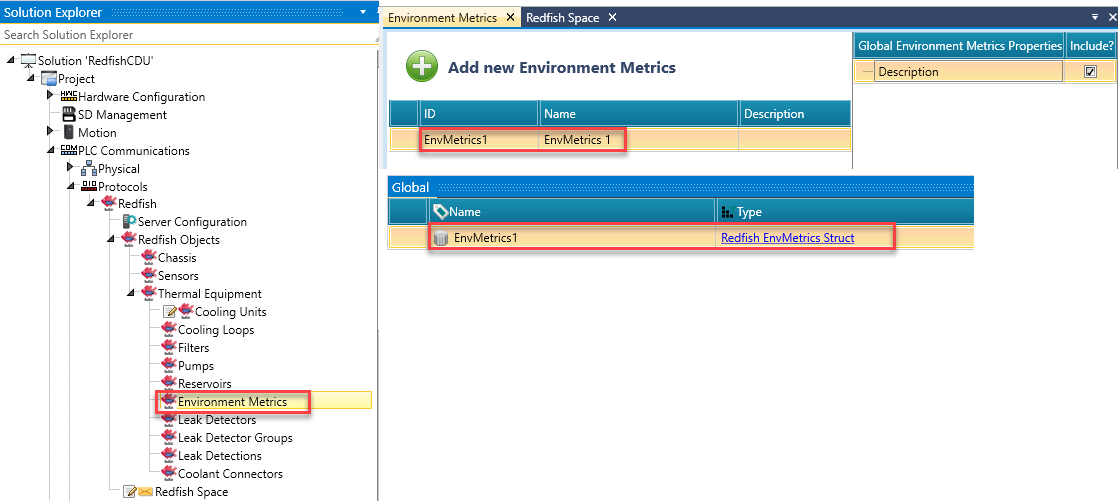
Thermal Equipment - Environment Metrics

  1. Select Thermal Equipment on the Solution Explorer > Environment Metrics > Add new Environment Metrics.

  2. UniLogic automatically assigns editable ID, Name and Description fields. 

  3. Select to include or exclude the required Properties by checking/unchecking the Properties check-boxes.

  4. UniLogic creates the Environment Metrics with the supporting Environment Metrics struct.

  5. Select Redfish Space on the Solution Explorer > Cooling Units > Cooling Unit > Environment Metrics and link your Environment Metrics struct.

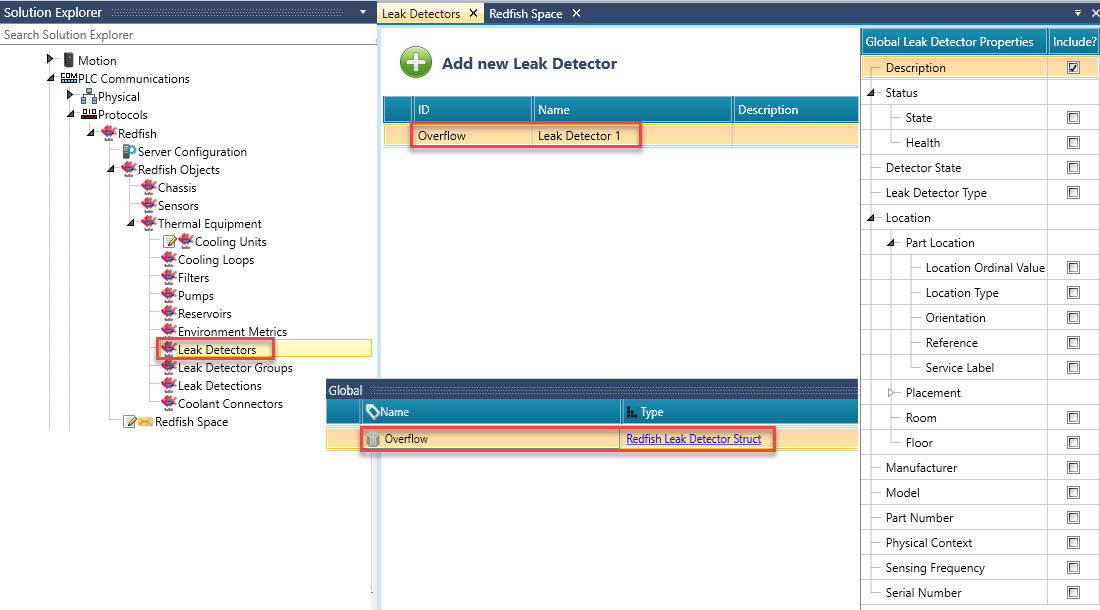
Thermal Equipment - Leak Detectors

  1. Select Thermal Equipment on the Solution Explorer > Leak Detectors > Add new Leak Detector.

  2. UniLogic automatically assigns editable ID, Name and Description fields. 

  3. Select to include or exclude the required Properties by checking/unchecking the Properties check-boxes.

  4. UniLogic creates the Leak Detector with the supporting Leak Detector struct.

  5. Select Redfish Space on the Solution Explorer > Cooling Units > Cooling Unit > Leak Detection > Leak Detectors > Add New Leak Detector and link your Leak Detector struct.

Thermal Equipment - Leak Detections

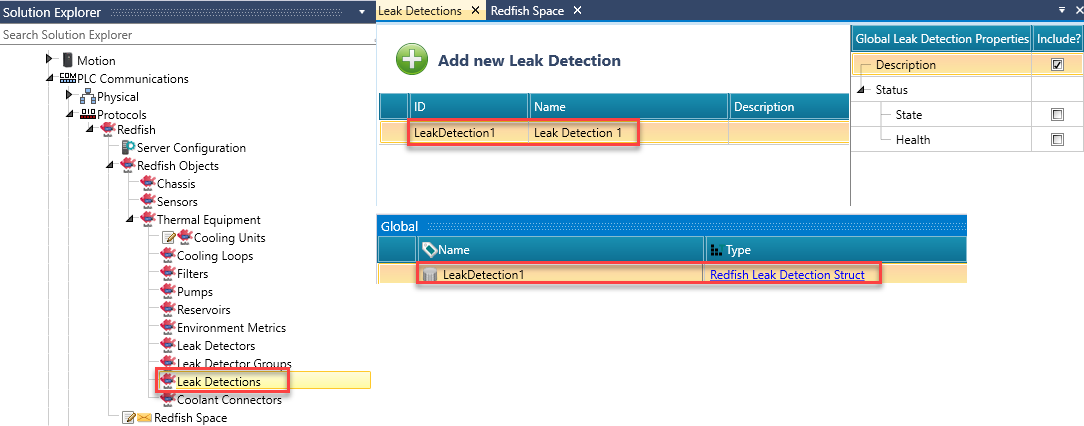
  1. Select Thermal Equipment on the Solution Explorer > Leak Detections > Add new Leak Detection.

  2. UniLogic automatically assigns editable ID, Name and Description fields. 

  3. Select to include or exclude the required Properties by checking/unchecking the Properties check-boxes.

  4. UniLogic creates the Leak Detection with the supporting Leak Detection struct.

  5. Select Redfish Space on the Solution Explorer > Cooling Units > Cooling Unit >  Leak Detection and link your Leak Detection struct.

Thermal Equipment - Coolant Connectors

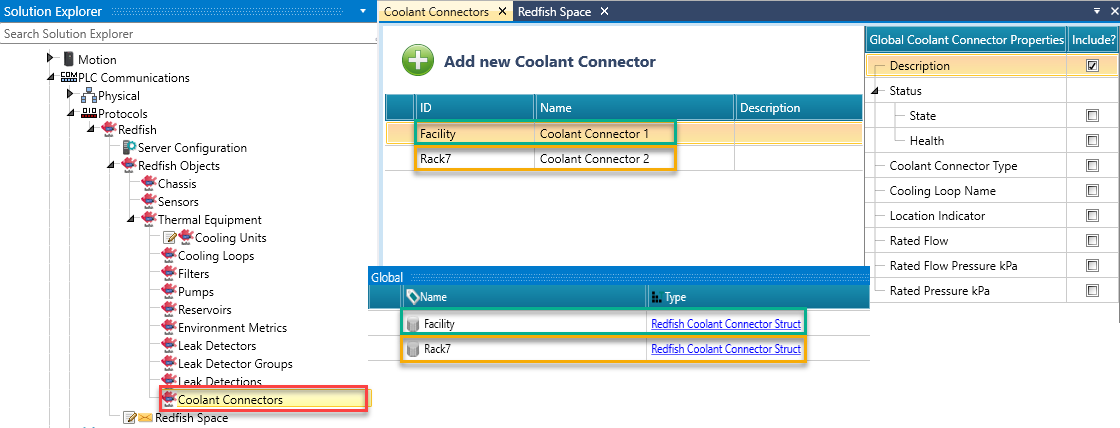
  1. Select Thermal Equipment on the Solution Explorer > Coolant Connectors > Add new Coolant Connector.

  2. UniLogic automatically assigns editable ID, Name and Description fields. 

  3. Select to include or exclude the required Properties by checking/unchecking the Properties check-boxes.

  4. UniLogic creates two Coolant Connectors with their supporting Coolant Connector structs.

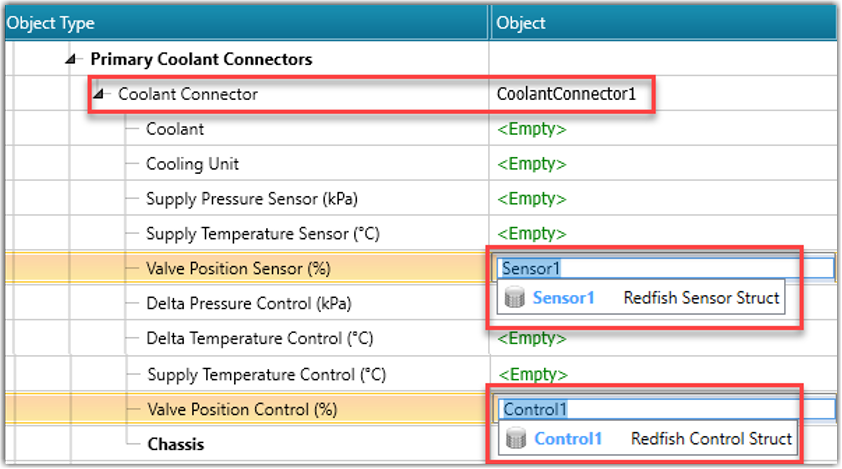
  5. Select Redfish Space on the Solution Explorer > Cooling Units > Cooling Unit > Primary Coolant Connectors > Add New Coolant Connector and link your "Facility" Coolant Connector Struct.

  6. Select Redfish Space on the Solution Explorer > Cooling Units > Cooling Unit > Secondary Coolant Connectors > Add New Coolant Connector and link your "Rack7" Coolant Connector Struct.


Redfish Space

This is where you link complete resource collection structs as well as members array within a resource collection.

  1. Select Redfish Space on the Solution Explorer.

  2. Click on an Object Type to expand the resource tree and link the required resource configured in the Redfish Objects.
    Bolded Object Types allow for adding new objects and for linking both resource collections and individual resources.


Redfish Chassis Struct values

Name

Data Type

Definition

ID

STRING-ASCII

This is a unique ID name

Name

STRING-ASCII

This is a name that you assign for your own reference.

Description

STRING-ASCII

A brief textual explanation of the object or resource.

Chassis Type


UINT8


The type of physical form factor of the chassis

0= Blade

An enclosed or semi-enclosed, typically vertically-oriented, system chassis that must be plugged into a multi-system chassis to function normally

1= Card

A loose device or circuit board intended to be installed in a system or other enclosure

2= Cartridge

A small self-contained system intended to be plugged into a multi-system chassis

3= Component

A small chassis, card, or device that contains devices for a particular subsystem or function

4= Drawer

An enclosed or semi-enclosed, typically horizontally-oriented, system chassis that can be slid into a multisystem chassis

5= Enclosure

A generic term for a chassis that does not fit any other description

6= Expansion

A chassis that expands the capabilities or capacity of another chassis

7= HeatExchanger

A heat exchanger (v1.23+)

8= ImmersionTank

An immersion cooling tank (v1.23+)

9= IPBasedDrive

A chassis in a drive form factor with IP-based network connections (v1.3+)

10= Module

A small, typically removable, chassis or card that contains devices for a particular subsystem or function

11= Other

A chassis that does not fit any of these definitions

12= Pod

A collection of equipment racks in a large, likely transportable, container

13= PowerStrip

A power strip, typically placed in the zero-U space of a rack (v1.25+)

14= Rack

An equipment rack, typically a 19-inch wide freestanding unit

15= RackGroup

A group of racks that form a single entity or share infrastructure (v1.4+)

16= RackMount

A single-system chassis designed specifically for mounting in an equipment rack

17= Row

A collection of equipment racks

18= Shelf

An enclosed or semi-enclosed, typically horizontally-oriented, system chassis that must be plugged into a multi-system chassis to function normally

19= Sidecar

A chassis that mates mechanically with another chassis to expand its capabilities or capacity

20= Sled

An enclosed or semi-enclosed, system chassis that must be plugged into a multi-system chassis to function normally similar to a blade type chassis

21= StandAlone

A single, free-standing system, commonly called a tower or desktop chassis

22= StorageEnclosure

A chassis that encloses storage (v1.6+)

23= Zone

A logical division or portion of a physical chassis that contains multiple devices or systems that cannot be physically separated

Manufacturer

STRING-ASCII

The manufacturer of this chassis

Location Ordinal Value

UINT32

The number that represents the location of the part

Location Type


UINT8


The type of location of the part

0= Backplane

A backplane (v1.12+)

1= Bay

A bay

2= Connector

A connector or port

3= Embedded

Embedded within a part (v1.13+)

4= Slot

A slot

5= Socket

A socket

Orientation


UINT8


The orientation for the ordering of the slot enumeration

0= BackToFront

The ordering for the LocationOrdinalValue is back to front

1= BottomToTop

The ordering for LocationOrdinalValue is bottom to top

2= FrontToBack

The ordering for LocationOrdinalValue is front to back

3= LeftToRight

The ordering for the LocationOrdinalValue is left to right

4= RightToLeft

The ordering for the LocationOrdinalValue is right to left

Reference


UINT8


The reference point for the part location. Provides guidance about the general location of the part

0= Bottom

The part is in the bottom of the unit

1= Front

The part is in the front of the unit

2= Left

The part is on the left side of the unit

3= Middle

The part is in the middle of the unit

4= Rear

The part is in the rear of the unit

5= Right

The part is on the right side of the unit

6= Top

The part is in the top of the unit

Service Label

STRING-ASCII

Used to identify or describe a service

Location Info

STRING-ASCII

Used to provide information about a location

Location Rack

STRING-ASCII

Identifies the specific rack or slot location within a system or physical environment

Location Row

STRING-ASCII

Indicates the row within a physical structure

Location Offset

INT32

Represents an offset or positional adjustment within a location

Rack Offset Units


UINT8


The type of rack units in use

0= EIA_310

A rack unit that is equal to 1.75 in (44.45 mm)

1= OpenU

A rack unit that is equal to 48 mm (1.89 in)

Room

STRING-ASCII

Provides the name or identifier of a room

Floor

STRING-ASCII

Specifies the floor or level where a location or item is situated

Model

STRING-ASCII

Provides the model name or number for a product or component

Serial Number

STRING-ASCII

Used to uniquely identify the serial number

Part Number

STRING-ASCII

Provides a unique identifier for a specific part or component

Status State

BIT

Indicates the current status or state of the object

Status Health


UINT8


Represents the health status of the object or resource

0= Critical

A critical condition requires immediate attention

1= OK

Normal

2= Warning

A condition requires attention

Redfish Control Struct values

Name

Data Type

Definition

ID

STRING-ASCII

This is a unique ID name

Name

STRING-ASCII

This is a name that you assign for your own reference.

Description

STRING-ASCII

A brief textual explanation of the object or resource.

Status State

BIT

Indicates the current status or state of the object

Status Health


UINT8


Represents the health status of the object or resource

0= Critical

A critical condition requires immediate attention

1= OK

Normal

2= Warning

A condition requires attention

Location Ordinal Value

UINT32

The number that represents the location of the control

Location Type


UINT8


The type of location of the part

0= Backplane

A backplane (v1.12+)

1= Bay

A bay

2= Connector

A connector or port

3= Embedded

Embedded within a part (v1.13+)

4= Slot

A slot

5= Socket

A socket

Orientation


UINT8


The orientation for the ordering of the slot enumeration

0= BackToFront

The ordering for the LocationOrdinalValue is back to front

1= BottomToTop

The ordering for LocationOrdinalValue is bottom to top

2= FrontToBack

The ordering for LocationOrdinalValue is front to back

3= LeftToRight

The ordering for the LocationOrdinalValue is left to right

4= RightToLeft

The ordering for the LocationOrdinalValue is right to left

Reference


UINT8


The reference point for the part location. Provides guidance about the general location of the part

0= Bottom

The part is in the bottom of the unit

1= Front

The part is in the front of the unit

2= Left

The part is on the left side of the unit

3= Middle

The part is in the middle of the unit

4= Rear

The part is in the rear of the unit

5= Right

The part is on the right side of the unit

6= Top

The part is in the top of the unit

Service Label

STRING-ASCII

Used to identify or describe a service

Location Info

STRING-ASCII

Used to provide information about a location

Location Rack

STRING-ASCII

Identifies the specific rack or slot location within a system or physical environment

Location Row

STRING-ASCII

Indicates the row within a physical structure

Location Offset

INT32

Represents an offset or positional adjustment within a location

Rack Offset Units


UINT8


The type of rack units in use

0= EIA_310

A rack unit that is equal to 1.75 in (44.45 mm)

1= OpenU

A rack unit that is equal to 48 mm (1.89 in)

Room

STRING-ASCII

Provides the name or identifier of a room

Floor

STRING-ASCII

Specifies the floor or level where a location or item is situated

Allowable Max

REAL

The maximum possible setting for this control. This property shall indicate the maximum possible value of the SetPoint or SettingMax properties for this control. Services shall not accept values for SetPoint or SettingMax above this value.

Allowable Min

REAL

The minimum possible setting for this control. This property shall indicate the minimum possible value of the SetPoint or SettingMin properties for this control. Services shall not accept values for SetPoint or SettingMin below this value.

Control Delay Seconds

REAL

The time delay in seconds before the control will activate once the value has deviated from the set point. This property shall contain the time in seconds that will elapse after the control value deviates above or below the value of SetPoint before the control will activate.

Coefficient Update Time

STRING-ASCII

The date and time that the control loop coefficients were changed. This property shall contain the date and time that any of the coefficients for the control loop were last changed.

Differential

REAL

The differential coefficient. This property shall contain the coefficient for the differential factor in a control loop.

Integral

REAL

The integral coefficient. This property shall contain the coefficient for the integral factor in a control loop.

Proportional

REAL

The proportional coefficient. This property shall contain the coefficient for the proportional factor in a control loop.

Control Mode


UINT8


The current operating mode of the control.

0=Automatic

Automatically adjust control to meet the set point.

1=Disabled

The control has been disabled.

2=Manual

No automatic adjustments are made to the control.

3=Override

User override of the automatic set point value.

Control Type


UINT8


The type of control

0=DutyCycle (v1.5+)

Duty cycle (%) control. This value shall indicate a control used to adjust the duty cycle, such as a PWM-based control, in percent units. The SetPointUnits property shall contain % .

1=Frequency

Frequency (Hz) control. This value shall indicate a control used to limit the operating frequency, in hertz units, of a device, either to a single set point or within a range. The SetPointUnits property shall contain Hz.

2=FrequencyMHz (v1.1+)

Frequency (MHz) control. This value shall indicate a control used to limit the operating frequency, in megahertz units, of a device, either to a single set point or within a range. The SetPointUnits property shall contain MHz .

3=LiquidFlowLPM (v1.6+)

Liquid flow (L/min) control. This value shall indicate a control used to adjust the volume of liquid per unit of time, in liters per minute units, that flows through a particular junction. The SetPointUnits property shall contain L/ min .

4=Percent (v1.5+)

Percent-based control. This value shall indicate a percent-based control, in percent units. The SetPointUnits property shall contain % .

5=Power

Power (W) control or power limit. This value shall indicate a control used to regulate or limit maximum power consumption, in watt units, either to a single set point or within a range. The SetPointUnits property shall contain W .

6=PressurekPa (v1.3+)

Pressure (kPa) control. This value shall indicate a control used to adjust pressure in a system, in kilopascal units. The SetPointUnits property shall contain kPa .

7=Temperature

Temperature (C) control or thermostat. This value shall indicate a control used to regulate temperature, in degree Celsius units, either to a single set point or within a range. The SetPointUnits property shall contain Cel .

8=Valve (v1.3+)

Valve (% open) control. This value shall indicate a control used to adjust a valve in a system, in percent units. The SetPointUnits property shall contain % . A value of 100 shall indicate the valve is completely open, and a value of 0 shall indicate the valve is completely closed.

Dead Band

REAL

The maximum deviation from the set point allowed before the control will activate.

Default Set Point

REAL

The default set point of the control.

Implementation


UINT8


The The implementation of the control.

0=Direct

The set point directly affects the control value.

1=Monitored

A physical control that cannot be adjusted through this interface.

2=Programmable

The set point can be adjusted through this interface.

Increment

REAL

The smallest increment supported for the set point.

Physical Context


UINT8


The area or device to which this control applies

0= Accelerator

An accelerator

1= ACInput

An AC input

2= ACMaintenanceBypassInput

An AC maintenance bypass input

3= ACOutput

An AC output

4= ACStaticBypassInput

An AC static bypass input

5= ACUtilityInput

An AC utility input

6= ASIC

An ASIC device, such as a networking chip or chipset component

7= Back

The back of the chassis

8= Backplane

A backplane within the chassis

9= Battery

A battery

10= Board

A circuit board

11= Chassis

The entire chassis

12= ComputeBay

Within a compute bay

13= CoolingSubsystem

The entire cooling, or air and liquid, subsystem

14= CPU

A processor (CPU)

15= CPUSubsystem

The entire processor (CPU) subsystem

16= DCBus

A DC bus

17= Exhaust

The air exhaust point or points or region of the chassis

18= ExpansionBay

Within an expansion bay

19= Fan

A fan

20= FPGA

An FPGA

21= Front

The front of the chassis

22= GPU

A graphics processor (GPU)

23= GPUSubsystem

The entire graphics processor (GPU) subsystem

24= Intake

The air intake point or points or region of the chassis

25= LiquidInlet

The liquid inlet point of the chassis

26= LiquidOutlet

The liquid outlet point of the chassis

27= Lower

The lower portion of the chassis

28= Memory

A memory device

29= MemorySubsystem

The entire memory subsystem

30= Motor

A motor

31= NetworkBay

Within a networking bay

32= NetworkingDevice

A networking device

33= PowerSubsystem

The entire power subsystem

34= PowerSupply

A power supply

35= PowerSupplyBay

Within a power supply bay

36= Pump

A pump

37= Rectifier

A rectifier device

38= Room

The room

39= StorageBay

Within a storage bay

40= StorageDevice

A storage device

41=StorageSubsystem

A storage subsystem

42=Switch

A switch device

43= SystemBoard

The system board (PCB)

44= Transceiver

A transceiver

45= Transformer

A transformer

46= TrustedModule

A trusted module

47= Upper

The upper portion of the chassis

48= VoltageRegulator

A voltage regulator device

Physical Sub Context


UINT8


The usage or location within a device to which this control applies.

0=Input

The input.

1=Output

The output.

Set Point

REAL

The desired set point of the control.

Set Point Accuracy

REAL

Accuracy (+/-) of the set point. This property shall contain the accuracy of the value of the SetPoint for this control. The value shall be the absolute value of the maximum deviation of the SetPoint from its actual value. The value shall be in units that follow the SetPointUnits for this control.

Set Point Type


UINT8


The set point type used to operate the control.

0=Range

Control uses a range of values. This value shall indicate the control utilizes a set point range for its operation. The SettingMin and SettingMax properties shall be present for this control type. The SetPoint property shall not be present for this control type

1=Single

Control uses a single set point. This value shall indicate the control utilizes a single set point for its operation. The SetPoint property shall be present for this control type. The SettingMin and SettingMax properties shall not be present for this control type.

Set Point Units

STRING-ASCII

The units of the set point and related properties in UCUM c/s format.

Set Point Update Time

STRING-ASCII

The date and time that the set point was changed.

Setting Max

REAL

The maximum set point in the allowed range.

Setting Min

REAL

The minimum set point in the allowed range.


Redfish Cooling Unit Struct values

Name

Data Type

Definition

ID

STRING-ASCII

This is a unique ID name

Name

STRING-ASCII

This is a name that you assign for your own reference

Description

STRING-ASCII

A brief textual explanation of the object or resource

Status State

BIT

Indicates the current status or state of the object

Status Health


UINT8


Represents the health status of the object or resource

0= Critical

A critical condition requires immediate attention

1= OK

Normal

2= Warning

A condition requires attention

Cooling Capacity Watts

UINT32

Specifies the maximum cooling capacity of a system or component

Equipment Type


UINT8


Equipment Type Options

0= CDU

A coolant distribution unit (CDU)

1= HeatExchanger

A heat exchanger

2= ImmersionUnit

An immersion cooling unit

Firmware Version

STRING-ASCII

The firmware version of this equipment

Location Ordinal Value

UINT32

The number that represents the location of the part

Location Type


UINT8


The type of location of the part

0= Backplane

A backplane (v1.12+)

1= Bay

A bay

2= Connector

A connector or port

3= Embedded

Embedded within a part (v1.13+)

4= Slot

A slot

5= Socket

A socket

Orientation


UINT8


The orientation for the ordering of the slot enumeration

0= BackToFront

The ordering for the LocationOrdinalValue is back to front

1= BottomToTop

The ordering for LocationOrdinalValue is bottom to top

2= FrontToBack

The ordering for LocationOrdinalValue is front to back

3= LeftToRight

The ordering for the LocationOrdinalValue is left to right

4= RightToLeft

The ordering for the LocationOrdinalValue is right to left

Reference


UINT8


The reference point for the part location. Provides guidance about the general location of the part

1= Bottom

The part is in the bottom of the unit

2= Front

The part is in the front of the unit

3= Left

The part is on the left side of the unit

4= Middle

The part is in the middle of the unit

5= Rear

The part is in the rear of the unit

6= Right

The part is on the right side of the unit

7= Top

The part is in the top of the unit

Service Label

STRING-ASCII

Used to identify or describe a service

Location Info

STRING-ASCII

Used to provide information about a location

Location Rack

STRING-ASCII

Identifies the specific rack or slot location within a system or physical environment

Location Row

STRING-ASCII

Indicates the row within a physical structure

Location Offset

INT32

Represents an offset or positional adjustment within a location.

Rack Offset Units


UINT8


The type of rack units in use

0= EIA_310

A rack unit that is equal to 1.75 in (44.45 mm)

1= OpenU

A rack unit that is equal to 48 mm (1.89 in)

Room

STRING-ASCII

Provides the name or identifier of a room

Floor

STRING-ASCII

Specifies the floor or level where a location or item is situated

Manufacturer

STRING-ASCII

The manufacturer of this equipment

Model

STRING-ASCII

Provides the model name or number for a product or component

Part Number

STRING-ASCII

Provides a unique identifier for a specific part or component

Serial Number

STRING-ASCII

Used to uniquely identify the serial number


Redfish Cooling Loops Struct values

Name

Data Type

Definition

ID

STRING-ASCII

This is a unique ID name

Name

STRING-ASCII

This is a name that you assign for your own reference.

Description

STRING-ASCII

A brief textual explanation of the object or resource.

Additive Name

STRING-ASCII

Provides the name of an additive

Additive Percent

REAL

Indicates the proportion of an additive relative to the total mixture

Coolant Type


UINT8


Specifies the type of coolant

0= Dielectric

Dielectric fluid

1= Fluorocarbon

Fluorocarbon-based

2= Hydrcarbon

Hydrocarbon-based

3= Water

Water or glycol mixture, including additives

Density Kg Per Cubic Meter

REAL

Specifies the density of a substance

Rated Service Hours

REAL

Indicates the expected or recommended number of operational hours before maintenance or replacement is needed

Service Date

STRING-ASCII

Provides the date when service or maintenance was performed

Service Hours

REAL

Indicates the total time dedicated to service or maintenance tasks

Specific Heat kJoules Per KgK

REAL

Represents the specific heat capacity of a substance, measured in kilojoules per kilogram-kelvin (kJ/kg·K)

Coolant Level Status


UINT8


Indicates the current status or level of coolant

0= Critical

A critical condition requires immediate attention

1= OK

Normal

2= Warning

A condition requires attention

Coolant Quality


UINT8


Indicates the quality or condition of the coolant

0= Critical

A critical condition requires immediate attention

1= OK

Normal

2= Warning

A condition requires attention

Location Indicator

BIT

Used to represent a simple binary state or condition related to location

Rated Flow

REAL

Specifies the designed or nominal flow rate that the system or component is rated to handle

Rated Pressure kPa

Real

Specifies the maximum or nominal pressure that a system or component is rated to handle

Status State

BIT

Indicates the current status or state of the object

Status Health


UINT8


Represents the health status of the object or resource

0= Critical

A critical condition requires immediate attention

1= OK

Normal

2= Warning

A condition requires attention


Redfish Filter Struct values

Name

Data Type

Definition

ID

STRING-ASCII

This is a unique ID name

Name

STRING-ASCII

This is a name that you assign for your own reference.

Description

STRING-ASCII

A brief textual explanation of the object or resource.

Status State

BIT

Indicates the current status or state of the object

Status Health


UINT8


Represents the health status of the object or resource

0= Critical

A critical condition requires immediate attention

1= OK

Normal

2= Warning

A condition requires attention

Hot Pluggable

BIT

Indicates whether a component or device can be inserted or removed while the system is operating without needing to power down

Location Ordinal Value

UINT32

The number that represents the location of the part

Location Type


UINT8


The type of location of the part

0= Backplane

A backplane (v1.12+)

1= Bay

A bay

2= Connector

A connector or port

3= Embedded

Embedded within a part (v1.13+)

4= Slot

A slot

5= Socket

A socket

Orientation


UINT8


The orientation for the ordering of the slot enumeration

0= BackToFront

The ordering for the LocationOrdinalValue is back to front

1= BottomToTop

The ordering for LocationOrdinalValue is bottom to top

2= FrontToBack

The ordering for LocationOrdinalValue is front to back

3= LeftToRight

The ordering for the LocationOrdinalValue is left to right

4= RightToLeft

The ordering for the LocationOrdinalValue is right to left

Reference


UINT8


The reference point for the part location. Provides guidance about the general location of the part

0= Bottom

The part is in the bottom of the unit

1= Front

The part is in the front of the unit

2= Left

The part is on the left side of the unit

3= Middle

The part is in the middle of the unit

4= Rear

The part is in the rear of the unit

5= Right

The part is on the right side of the unit

6= Top

The part is in the top of the unit

Service Label

STRING-ASCII

Used to identify or describe a service

Location Info

STRING-ASCII

Used to provide information about a location

Location Rack

STRING-ASCII

Identifies the specific rack or slot location within a system or physical environment

Location Row

STRING-ASCII

Indicates the row within a physical structure

Location Offset

INT32

Represents an offset or positional adjustment within a location.

Rack Offset Units


UINT8


Represents the units used for the rack offset

0= EIA_310

A rack unit that is equal to 1.75 in (44.45 mm)

1= OpenU

A rack unit that is equal to 48 mm (1.89 in)

Room

STRING-ASCII

Provides the name or identifier of a room

Floor

STRING-ASCII

Specifies the floor or level where a location or item is situated

Location Indicator

BIT

Used to represent a simple binary state or condition related to location

Manufacturer

STRING-ASCII

The name of the manufacturer

Model

STRING-ASCII

Provides the model name or number for a product or component

Part Number

STRING-ASCII

Provides a unique identifier for a specific part or component

Physical Context


UINT8


The area or device to which this leak filter applies

0= Accelerator

An accelerator

1= ACInput

An AC input

2= ACMaintenanceBypassInput

An AC maintenance bypass input

3= ACOutput

An AC output

4= ACStaticBypassInput

An AC static bypass input

5= ACUtilityInput

An AC utility input

6= ASIC

An ASIC device, such as a networking chip or chipset component

7= Back

The back of the chassis

8= Backplane

A backplane within the chassis

9= Battery

A battery

10= Board

A circuit board

11= Chassis

The entire chassis

12= ComputeBay

Within a compute bay

13= CoolingSubsystem

The entire cooling, or air and liquid, subsystem

14= CPU

A processor (CPU)

15= CPUSubsystem

The entire processor (CPU) subsystem

16= DCBus

A DC bus

17= Exhaust

The air exhaust point or points or region of the chassis

18= ExpansionBay

Within an expansion bay

19= Fan

A fan

20= FPGA

An FPGA

21= Front

The front of the chassis

22= GPU

A graphics processor (GPU)

23= GPUSubsystem

The entire graphics processor (GPU) subsystem

24= Intake

The air intake point or points or region of the chassis

25= LiquidInlet

The liquid inlet point of the chassis

26= LiquidOutlet

The liquid outlet point of the chassis

27= Lower

The lower portion of the chassis

28= Memory

A memory device

29= MemorySubsystem

The entire memory subsystem

30= Motor

A motor

31= NetworkBay

Within a networking bay

32= NetworkingDevice

A networking device

33= PowerSubsystem

The entire power subsystem

34= PowerSupply

A power supply

35= PowerSupplyBay

Within a power supply bay

36= Pump

A pump

37= Rectifier

A rectifier device

38= Room

The room

39= StorageBay

Within a storage bay

40= StorageDevice

A storage device

41= SystemBoard

The system board (PCB)

42= Transceiver

A transceiver

43= Transformer

A transformer

44= TrustedModule

A trusted module

45= Upper

The upper portion of the chassis

46= VoltageRegulator

A voltage regulator device

Rated Service Hours

REAL

The number of hours a device or component is rated to operate under normal conditions

Replaceable

BIT

Indicates whether a component or part can be replaced

Service Date

STRING-ASCII

Represents the date on which the service was performed.

Service Hours

REAL

Represents the total number of hours spent on service or maintenance.


Redfish Pump Struct values

Name

Data Type

Definition

ID

STRING-ASCII

This is a unique ID name

Name

STRING-ASCII

This is a name that you assign for your own reference.

Description

STRING-ASCII

A brief textual explanation of the object or resource.

Status State

BIT

Indicates the current status or state of the object

Status Health


UINT8


Represents the health status  of the object or resource

0= Critical

A critical condition requires immediate attention

1= OK

Normal

2= Warning

A condition requires attention

Firmware Version

STRING-ASCII

Represents the version of the firmware

Location Ordinal Value

UINT32

The number that represents the location of the part

Location Type


UINT8


The type of location of the part

0= Backplane

A backplane (v1.12+)

1= Bay

A bay

2= Connector

A connector or port

3= Embedded

Embedded within a part (v1.13+)

4= Slot

A slot

5= Socket

A socket

Orientation


UINT8


The orientation for the ordering of the slot enumeration

0= BackToFront

The ordering for the LocationOrdinalValue is back to front

1= BottomToTop

The ordering for LocationOrdinalValue is bottom to top

2= FrontToBack

The ordering for LocationOrdinalValue is front to back

3= LeftToRight

The ordering for the LocationOrdinalValue is left to right

4= RightToLeft

The ordering for the LocationOrdinalValue is right to left

Reference


UINT8


The reference point for the part location. Provides guidance about the general location of the part

0= Bottom

The part is in the bottom of the unit

1= Front

The part is in the front of the unit

2= Left

The part is on the left side of the unit

3= Middle

The part is in the middle of the unit

4= Rear

The part is in the rear of the unit

5= Right

The part is on the right side of the unit

6= Top

The part is in the top of the unit

Service Label

STRING-ASCII

Used to identify or describe a service

Location Info

STRING-ASCII

Used to provide information about a location

Location Rack

STRING-ASCII

Identifies the specific rack or slot location within a system or physical environment

Location Row

STRING-ASCII

Indicates the row within a physical structure

Location Offset

INT32

Represents an offset or positional adjustment within a location.

Rack Offset Units


UINT8


Represents the units used for the rack offset

0= EIA_310

A rack unit that is equal to 1.75 in (44.45 mm)

1= OpenU

A rack unit that is equal to 48 mm (1.89 in)

Room

STRING-ASCII

Provides the name or identifier of a room

Floor

STRING-ASCII

Specifies the floor or level where a location or item is situated

Location Indicator

BIT

Used to represent a simple binary state or condition related to location

Manufacturer

STRING-ASCII

The name of the manufacturer

Model

STRING-ASCII

Provides the model name or number for a product or component

Part Number

STRING-ASCII

Provides a unique identifier for a specific part or component

Physical Context


UINT8


The area or device to which this pump applies

0= Accelerator

An accelerator

1= ACInput

An AC input

2= ACMaintenanceBypassInput

An AC maintenance bypass input

3= ACOutput

An AC output

4= ACStaticBypassInput

An AC static bypass input

5= ACUtilityInput

An AC utility input

6= ASIC

An ASIC device, such as a networking chip or chipset component

7= Back

The back of the chassis

8= Backplane

A backplane within the chassis

9= Battery

A battery

10= Board

A circuit board

11= Chassis

The entire chassis

12= ComputeBay

Within a compute bay

13= CoolingSubsystem

The entire cooling, or air and liquid, subsystem

14= CPU

A processor (CPU)

15= CPUSubsystem

The entire processor (CPU) subsystem

16= DCBus

A DC bus

17= Exhaust

The air exhaust point or points or region of the chassis

18= ExpansionBay

Within an expansion bay

19= Fan

A fan

20= FPGA

An FPGA

21= Front

The front of the chassis

22= GPU

A graphics processor (GPU)

23= GPUSubsystem

The entire graphics processor (GPU) subsystem

24= Intake

The air intake point or points or region of the chassis

25= LiquidInlet

The liquid inlet point of the chassis

26= LiquidOutlet

The liquid outlet point of the chassis

27= Lower

The lower portion of the chassis

28= Memory

A memory device

29= MemorySubsystem

The entire memory subsystem

30= Motor

A motor

31= NetworkBay

Within a networking bay

32= NetworkingDevice

A networking device

33= PowerSubsystem

The entire power subsystem

34= PowerSupply

A power supply

35= PowerSupplyBay

Within a power supply bay

36= Pump

A pump

37= Rectifier

A rectifier device

38= Room

The room

39= StorageBay

Within a storage bay

40= StorageDevice

A storage device

41= SystemBoard

The system board (PCB)

42= Transceiver

A transceiver

43= Transformer

A transformer

44= TrustedModule

A trusted module

45= Upper

The upper portion of the chassis

46= VoltageRegulator

A voltage regulator device

Production Date

STRING-ASCII

Represents the date when a product was manufactured

Pump Type


UINT8


Specifies the  type  or model of a pump

0= Compressor

A compressor

1= Liquid

A water or liquid pump

Service Number

STRING-ASCII

Represents a unique identifier for a service event or record

Service Hours

REAL

Represents the total number of hours dedicated to service or maintenance

Version

STRING-ASCII

Provides the version number or identifier for software


Redfish Reservoir Struct values

Name

Data Type

Definition

ID

STRING-ASCII

This is a unique ID name

Name

STRING-ASCII

This is a name that you assign for your own reference.

Description

STRING-ASCII

A brief textual explanation of the object or resource.

Status State

BIT

Indicates the current status or state of the object

Status Health


UINT8


Represents the health status of the object or resource

0= Critical

A critical condition requires immediate attention

1= OK

Normal

2= Warning

A condition requires attention

Capacity Liters

REAL

Specifies the total volume or capacity of a container

Fluid Level Status


UINT8


Indicates the current status or level of fluid within a container or system

0= Critical

A critical condition requires immediate attention

1= OK

Normal

2= Warning

A condition requires attention

Location Ordinal Value

UINT32

The number that represents the location of the part

Location Type


UINT8


The type of location of the part

0= Backplane

A backplane (v1.12+)

1= Bay

A bay

2= Connector

A connector or port

3= Embedded

Embedded within a part (v1.13+)

4= Slot

A slot

5= Socket

A socket

Orientation


UINT8


The orientation for the ordering of the slot enumeration

0= BackToFront

he ordering for the LocationOrdinalValue is back to front

1= BottomToTop

The ordering for LocationOrdinalValue is bottom to top

2= FrontToBack

The ordering for LocationOrdinalValue is front to back

3= LeftToRight

The ordering for the LocationOrdinalValue is left to right

4= RightToLeft

The ordering for the LocationOrdinalValue is right to left

Reference


UINT8


The reference point for the part location. Provides guidance about the general location of the part

0= Bottom

The part is in the bottom of the unit

1= Front

The part is in the front of the unit

2= Left

The part is on the left side of the unit

3= Middle

The part is in the middle of the unit

4= Rear

The part is in the rear of the unit

5= Right

The part is on the right side of the unit

6= Top

The part is in the top of the unit

Service Label

STRING-ASCII

Used to identify or describe a service

Location Info

STRING-ASCII

Used to provide information about a location

Location Rack

STRING-ASCII

Identifies the specific rack or slot location within a system or physical environment

Location Row

STRING-ASCII

Indicates the row within a physical structure

Location Offset

INT32

Represents an offset or positional adjustment within a location.

Rack Offset Units


UINT8


Represents the units used for the rack offset

0= EIA_310

A rack unit that is equal to 1.75 in (44.45 mm)

1= OpenU

A rack unit that is equal to 48 mm (1.89 in)

Room

STRING-ASCII

Provides the name or identifier of a room

Floor

STRING-ASCII

Specifies the floor or level where a location or item is situated

Location Indicator

BIT

Used to represent a simple binary state or condition related to location

Manufacturer

STRING-ASCII

The name of the manufacturer

Model

STRING-ASCII

Provides the model name or number for a product or component

Part Number

STRING-ASCII

Provides a unique identifier for a specific part or component

Physical Context


UINT8


The area or device to which this leak detector applies

0= Accelerator

An accelerator

1= ACInput

An AC input

2= ACMaintenanceBypassInput

An AC maintenance bypass input

3= ACOutput

An AC output

4= ACStaticBypassInput

An AC static bypass input

5= ACUtilityInput

An AC utility input

6= ASIC

An ASIC device, such as a networking chip or chipset component

7= Back

The back of the chassis

8= Backplane

A backplane within the chassis

9= Battery

A battery

10= Board

A circuit board

11= Chassis

The entire chassis

12= ComputeBay

Within a compute bay

13= CoolingSubsystem

The entire cooling, or air and liquid, subsystem

14= CPU

A processor (CPU)

15= CPUSubsystem

The entire processor (CPU) subsystem

16= DCBus

A DC bus

17= Exhaust

The air exhaust point or points or region of the chassis

18= ExpansionBay

Within an expansion bay

19= Fan

A fan

20= FPGA

An FPGA

21= Front

The front of the chassis

22= GPU

A graphics processor (GPU)

23= GPUSubsystem

The entire graphics processor (GPU) subsystem

24= Intake

The air intake point or points or region of the chassis

25= LiquidInlet

The liquid inlet point of the chassis

26= LiquidOutlet

The liquid outlet point of the chassis

27= Lower

The lower portion of the chassis

28= Memory

A memory device

29= MemorySubsystem

The entire memory subsystem

30= Motor

A motor

31= NetworkBay

Within a networking bay

32= NetworkingDevice

A networking device

33= PowerSubsystem

The entire power subsystem

34= PowerSupply

A power supply

35= PowerSupplyBay

Within a power supply bay

36= Pump

A pump

37= Rectifier

A rectifier device

38= Room

The room

39= StorageBay

Within a storage bay

40= StorageDevice

A storage device

41= SystemBoard

The system board (PCB)

42= Transceiver

A transceiver

43= Transformer

A transformer

44= TrustedModule

A trusted module

45= Upper

The upper portion of the chassis

46= VoltageRegulator

A voltage regulator device

Reservoir Type


UINT8


Identifies the type  or classification of  a reservoir

0= Immersion

An immersion cooling tank

1= Inline

An inline or integrated reservoir

2= Overflow

An overflow reservoir for excess fluid

3= Reserve

A reservoir providing reserve fluid capacity

Serial Number

STRING-ASCII

Used to uniquely identify the serial number


Redfish Environment Metrics Struct values

Name

Data Type

Definition

ID

STRING-ASCII

This is a unique ID name

Name

STRING-ASCII

This is a name that you assign for your own reference.

Description

STRING-ASCII

A brief textual explanation of the object or resource.


Redfish Leak Detector Struct values

Name

Data Type

Definition

ID

STRING-ASCII

This is a unique ID name

Name

STRING-ASCII

This is a name that you assign for your own reference.

Description

STRING-ASCII

A brief textual explanation of the object or resource.

Status State

BIT

Indicates the current status or state of the object

Status Health


UINT8


Represents the health status of the object or resource

0= Critical

A critical condition requires immediate attention

1= OK

Normal

2= Warning

A condition requires attention

Detector State


UINT8


Indicates the operational state or status of a detector

0= Critical

A critical condition requires immediate attention

1= OK

Normal

2= Warning

A condition requires attention

Leak Detector Type


UINT8


Specifies the type or model of a leak detector

0= FloatSwitch

A float switch

1= Moisture

A moisture sensor

Location Ordinal Value

UINT32

The number that represents the location of the part

Location Type


UINT8


The type of location of the part

0= Backplane

A backplane (v1.12+)

1= Bay

A bay

2= Connector

A connector or port

3= Embedded

Embedded within a part (v1.13+)

4= Slot

A slot

5= Socket

A socket

Orientation


UINT8


The orientation for the ordering of the slot enumeration

0= BackToFront

he ordering for the LocationOrdinalValue is back to front

1= BottomToTop

The ordering for LocationOrdinalValue is bottom to top

2= FrontToBack

The ordering for LocationOrdinalValue is front to back

3= LeftToRight

The ordering for the LocationOrdinalValue is left to right

4= RightToLeft

The ordering for the LocationOrdinalValue is right to left

Reference

UINT8


The reference point for the part location. Provides guidance about the general location of the part

0= Bottom

The part is in the bottom of the unit

1= Front

The part is in the front of the unit

2= Left

The part is on the left side of the unit

3= Middle

The part is in the middle of the unit

4= Rear

The part is in the rear of the unit

5= Right

The part is on the right side of the unit

6= Top

The part is in the top of the unit

Service Label

STRING-ASCII

Used to identify or describe a service

Location Info

STRING-ASCII

Used to provide information about a location

Location Rack

STRING-ASCII

Identifies the specific rack or slot location within a system or physical environment

Location Row

STRING-ASCII

Indicates the row within a physical structure

Location Offset

INT32

Represents an offset or positional adjustment within a location.

Rack Offset Units


UINT8


Represents the units used for the rack offset

0= EIA_310

A rack unit that is equal to 1.75 in (44.45 mm)

1= OpenU

A rack unit that is equal to 48 mm (1.89 in)

Room

STRING-ASCII

Provides the name or identifier of a room

Floor

STRING-ASCII

Specifies the floor or level where a location or item is situated

Manufacturer

STRING-ASCII

The name of the manufacturer

Model

STRING-ASCII

Provides the model name or number for a product or component

Part Number

STRING-ASCII

Provides a unique identifier for a specific part or component

Physical Context


UINT8


The area or device to which this leak detector applies

0= Accelerator

An accelerator

1= ACInput

An AC input

2= ACMaintenanceBypassInput

An AC maintenance bypass input

3= ACOutput

An AC output

4= ACStaticBypassInput

An AC static bypass input

5= ACUtilityInput

An AC utility input

6= ASIC

An ASIC device, such as a networking chip or chipset component

7= Back

The back of the chassis

8= Backplane

A backplane within the chassis

9= Battery

A battery

10= Board

A circuit board

11= Chassis

The entire chassis

12= ComputeBay

Within a compute bay

13= CoolingSubsystem

The entire cooling, or air and liquid, subsystem

14= CPU

A processor (CPU)

15= CPUSubsystem

The entire processor (CPU) subsystem

16= DCBus

A DC bus

17= Exhaust

The air exhaust point or points or region of the chassis

18= ExpansionBay

Within an expansion bay

19= Fan

A fan

20= FPGA

An FPGA

21= Front

The front of the chassis

22= GPU

A graphics processor (GPU)

23= GPUSubsystem

The entire graphics processor (GPU) subsystem

24= Intake

The air intake point or points or region of the chassis

25= LiquidInlet

The liquid inlet point of the chassis

26= LiquidOutlet

The liquid outlet point of the chassis

27= Lower

The lower portion of the chassis

28= Memory

A memory device

29= MemorySubsystem

The entire memory subsystem

30= Motor

A motor

31= NetworkBay

Within a networking bay

32= NetworkingDevice

A networking device

33= PowerSubsystem

The entire power subsystem

34= PowerSupply

A power supply

35= PowerSupplyBay

Within a power supply bay

36= Pump

A pump

37= Rectifier

A rectifier device

38= Room

The room

39= StorageBay

Within a storage bay

40= StorageDevice

A storage device

41= SystemBoard

The system board (PCB)

42= Transceiver

A transceiver

43= Transformer

A transformer

44= TrustedModule

A trusted module

45= Upper

The upper portion of the chassis

46= VoltageRegulator

A voltage regulator device

Sensing Frequency

REAL

Defines the rate or frequency at which a sensing operation or measurement is performed.

Serial Number

STRING-ASCII

Used to uniquely identify the serial number


Redfish Leak Detection Struct values

Name

Data Type

Definition

ID

STRING-ASCII

This is a unique ID name

Name

STRING-ASCII

This is a name that you assign for your own reference.

Description

STRING-ASCII

A brief textual explanation of the object or resource.

Status State

BIT

Indicates the current status or state of the object

Status Health


UINT8


Represents the health status of the object or resource

0= Critical

A critical condition requires immediate attention

1= OK

Normal

2= Warning

A condition requires attention


Redfish Coolant Connector Struct values

Name

Data Type

Definition

ID

STRING-ASCII

This is a unique ID name

Name

STRING-ASCII

This is a name that you assign for your own reference.

Description

STRING-ASCII

A brief textual explanation of the object or resource.

Status State

BIT

Indicates the current status or state of the object

Status Health


UINT8


Represents the health status of the object or resource

0= Critical

A critical condition requires immediate attention

1= OK

Normal

2= Warning

A condition requires attention

Coolant Connector Type


UINT8


Specifies the type of coolant connector used in the system

0= Closed

A closed or self-contained loop

1= Inline

An inline connection or measurement point

2= Pair

A connection pair

3= Return

A return or outflow connection

4= Supply

A supply or intake connection

Cooling Loop Name

STRING-ASCII

The name assigned to the cooling loop in the system

Location Indicator


UINT8


A flag or code indicating the presence or specific location of an object or resource

0= Backplane

A backplane (v1.12+)

1= Bay

A bay

Rated Flow

REAL

The specified or maximum flow rate for a fluid or gas in the system

Rated Flow Pressure kpa

REAL

The pressure corresponding to the rated flow, measured in kilopascals (kPa)

Rated Pressure kpa

REAL

The maximum allowable pressure for the system, measured in kilopascals (kPa)